Car accidents in New Orleans rarely happen in a vacuum. They happen at tight French Quarter intersections, along high speed stretches of I 10, in school zones, near streetcar tracks and on neighborhood one way streets. Every one of those locations is governed by a web of Louisiana traffic statutes and New Orleans specific rules that can shift fault and change what your case is worth.
Branch Law is a New Orleans personal injury firm that focuses heavily on car accident cases across Orleans and Jefferson Parishes, with more than $150 million recovered for injured clients and over 18 years representing people hurt in crashes. (Source: Branch Law) That experience is built on knowing how local traffic laws really work on the ground.
This guide explains why your lawyer’s command of New Orleans traffic rules can be a real advantage, how key Louisiana statutes affect liability and value and how Branch Law uses those rules to build strong car accident claims.
Why Local Traffic Laws Matter After A New Orleans Car Accident
After a crash, insurance adjusters and courts look at more than just who tells the better story. They look at:
Which traffic statutes were violated
Where the crash happened and what local rules applied
How fault is divided under Louisiana’s comparative fault law
Whether any special penalties apply, such as the “no pay, no play” rule for uninsured drivers
Each of those issues is grounded in specific laws. When your attorney knows those statutes cold and understands how New Orleans police, judges and insurers apply them, it can:
a disputed liability case into one where the other driver is clearly at fault
Reduce your percentage of fault below critical cutoffs so you can still recover
Increase the amount an insurer is willing to pay at settlement
Branch Law’s own guides already focus on how comparative fault works and why local experience across New Orleans and nearby communities matters in car accident cases. (Source: Branch Law) (Source: Branch Law) This article goes a level deeper into the traffic laws themselves.
Louisiana Traffic Statutes That Often Decide Fault
Louisiana’s traffic code is found in Title 32 of the Revised Statutes. Several sections come up again and again in New Orleans car accident claims.
Following Too Closely And Rear End Collisions
Louisiana Revised Statute 32:81 says a driver may not follow another vehicle “more closely than is reasonable and prudent” considering speed, traffic and road conditions. (Source: FindLaw) In practice, this statute is one reason rear end crashes often start with a presumption that the trailing driver was at fault.
How it can affect your case:
If you were rear ended in stop and go traffic on Claiborne Avenue, a citation under 32:81 can strongly support your claim that the other driver was negligent
If you were the rear driver, your attorney may need to show a sudden emergency or other facts that make your following distance reasonable under the circumstances
Left And Failure To Yield
Many New Orleans crashes happen when one driver turns left across oncoming traffic. Louisiana Revised Statute 32:122 requires a driver left within an intersection to yield the right of way to vehicles coming from the opposite direction that are in the intersection or so close they are an immediate hazard. (Source: FindLaw)
Because of this rule, left drivers are often presumed to be at fault unless there is strong evidence the other driver ran a red light or was speeding excessively.
How it can affect your case:
If you were hit while going straight through an intersection and the other driver left across your lane, 32:122 can support a strong liability argument in your favor
If you were making the left , your lawyer may need detailed evidence about the light sequence, sight lines and speed of the oncoming vehicle to overcome the presumption
Passing And Lane Use On Highways
On multi lane roads and highways like I 10, Loyola Drive or the Pontchartrain Expressway, passing and lane rules matter. Louisiana Revised Statute 32:75 prohibits driving to the left of center to pass another vehicle unless the left side is clearly visible and free of oncoming traffic for enough distance to pass safely and to the right side at least 100 feet before any oncoming vehicle. (Source: FindLaw)
Unsafe passing, weaving and improper lane changes can shift a large share of fault onto an aggressive driver, even if the other driver made mistakes too.
Intersections And Right Of Way
Right of way rules at intersections and when entering roadways come from several statutes, including Louisiana Revised Statutes 32:121, 32:123 and related sections. Courts and insurers rely on these rules to decide who should have yielded:
Drivers must yield to vehicles already in the intersection
At most four way stops, the driver who arrives first has the right of way; if drivers arrive at the same time, the one on the left must yield to the one on the right
Drivers entering a highway from a driveway, alley or side street usually must yield to traffic already on the main road (Source: LegalClarity)
In a busy New Orleans intersection, a single missed yield can swing fault percentages sharply.
Distracted Driving And Cell Phone Use
Louisiana has specific statutes that address texting and cell phone use behind the wheel:
Louisiana Revised Statute 32:300.5 bans drivers from using a wireless device to write, send or read text based communications or to access social networking sites while operating a vehicle on a public road, with limited exceptions. (Source: FindLaw)
Separate statutes restrict cell phone use for new drivers and minors, limiting or barring handheld use while they are driving. (Source: Louisiana Highway Safety Commission)
If a phone record, witness statement or police report shows a driver was texting or scrolling social media before a crash, that violation can weigh heavily in how fault is assigned and how a jury the case.
Special Rules For Teen Drivers And School Zones
Louisiana law is especially strict when it comes to young drivers and school zones:
Louisiana Revised Statute 32:300.7 generally prohibits drivers 17 or younger from using any wireless telecommunications device to make calls or write, send or read text based communications while driving, except in limited emergencies. (Source: FindLaw)
Louisiana Revised Statute 32:300.8 bars drivers of any age from using a wireless device at all in active school zones during posted hours, including calls, texts and social media, again with narrow exceptions such as reporting an emergency. (Source: Justia)
In a New Orleans school zone crash, proof that a driver was on the phone can do more than support a traffic ticket. It can help an injury lawyer argue for a higher percentage of fault and, in some cases, punitive style damages or aggravated negligence arguments.
New Comparative Fault And Insurance Rules In 2025 And 2026
Knowing who violated which traffic law is only half the story. The other half is how Louisiana divides financial responsibility when more than one person is at fault.
From Pure Comparative Fault To A 51 Percent Bar
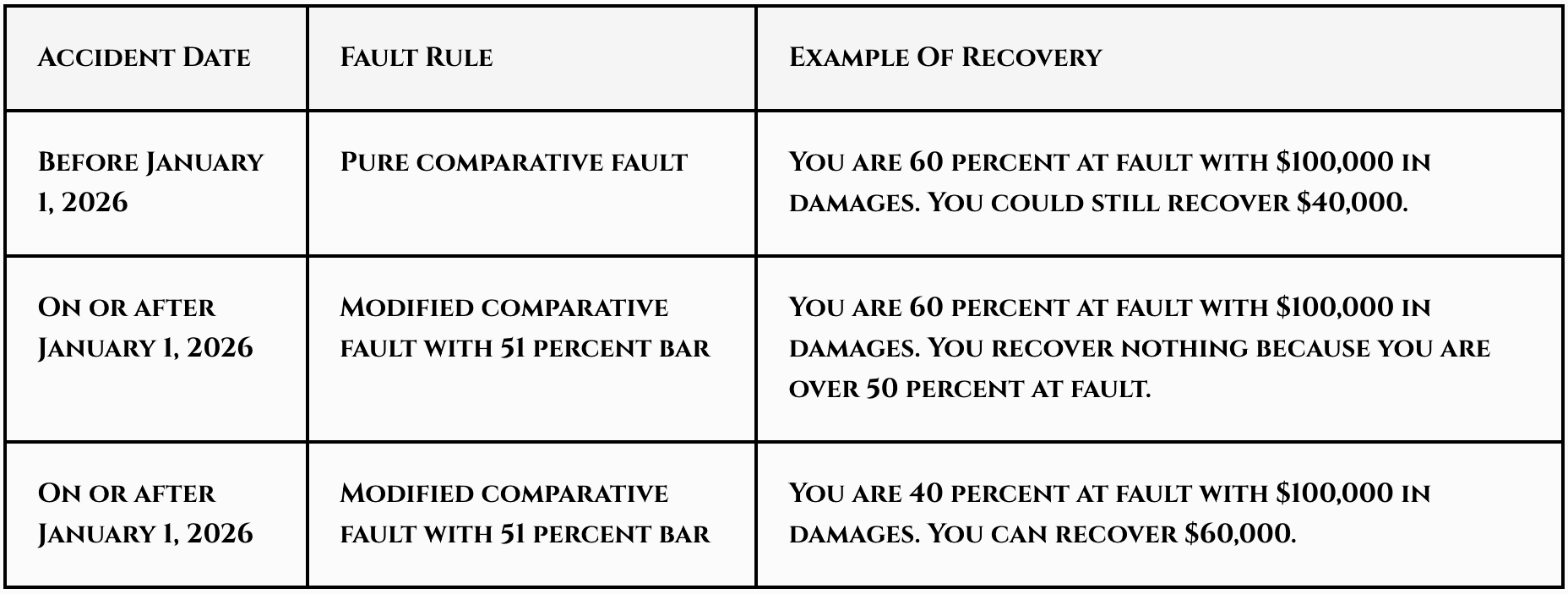
For decades, Louisiana followed a pure comparative fault system. Under that rule, an injured person could recover compensation even if they were mostly at fault, with their award reduced by their percentage of blame. A driver who was 80 percent at fault could still recover 20 percent of their damages from another negligent party.
In 2025, lawmakers passed Act 15 (House Bill 431), amending Louisiana Civil Code article 2323. For accidents on or after January 1, 2026, Louisiana moves to a modified comparative fault rule with a 51 percent bar to recovery. Under the new rule:
If you are 50 percent or less at fault, you can still recover compensation, reduced by your percentage of fault
If you are 51 percent or more at fault, you are barred from recovering any damages at all
This change applies prospectively. Crashes that happened before January 1, 2026 remain under the old pure comparative fault system, even if the claim or lawsuit is filed later.
Here is how that difference plays out:
With this new cutoff, small differences in fault percentages now matter more than ever. A detailed understanding of which traffic laws apply and how to argue them can move a case from 55 percent fault to 45 percent fault, which is now the difference between no compensation and a meaningful recovery.
The 2025 Expansion Of Louisiana’s No Pay No Play Law
Louisiana’s “no pay, no play” statute, Louisiana Revised Statute 32:866, limits how much an uninsured driver can recover after a crash, even when the other driver was at fault. Before recent reforms, an uninsured driver could not recover the first $15,000 of bodily injury damages and the first $25,000 of property damage. (Source: FindLaw)
Act 16 (House Bill 434), signed in May 2025 and effective August 1 2025, dramatically increased those amounts. Uninsured drivers in accidents on or after August 1 2025 are barred from recovering the first $100,000 in bodily injury damages and the first $100,000 in property damage, with limited exceptions.
This change means:
If you were uninsured and your total injuries and property damage are below $100,000, you may recover nothing from the at fault driver
An attorney who understands both no pay no play and the underlying traffic rules can advise you realistically about your options, identify any statutory exceptions and look for other insurance, such as uninsured motorist coverage.
New Orleans Realities That Change How Those Laws Apply
State statutes are only part of what makes New Orleans car accident claims unique. Local conditions and city level rules influence how those laws are interpreted and enforced.
Dense Urban Streets And One Way Routes
Downtown, Mid City and the French Quarter are packed with one way streets, unusual turn lanes and complex intersections. A driver unfamiliar with these patterns can easily violate a restriction, enter a one way street the wrong direction or make a last second lane change that conflicts with right of way rules.
Local knowledge helps your lawyer interpret diagrams in the police report, recognize when a driver ignored a one way sign or “no ” sign and explain those violations clearly to an adjuster or jury.
Streetcars, Neutral Grounds And Crosswalks
New Orleans streetcars run along neutral ground medians through areas like St Charles Avenue, Canal Street and Carrollton Avenue. Crashes near tracks and neutral grounds often raise questions about:
Whether a driver encroached into the neutral ground illegally
Whether a driver failed to yield to traffic approaching along the tracks
How pedestrians were using marked or unmarked crosswalks across the neutral ground
An attorney who regularly handles crashes at these intersections understands how traffic usually flows there, what photos to capture and what testimony is needed to show who violated the right of way.
School Zones, Cameras And Phone Restrictions
Greater New Orleans has many active school zones with strict speed limits and, in some areas, automated cameras. Combined with the statewide ban on handheld wireless device use in school zones, violations in these areas can be especially damaging to the at fault driver’s defense. (Source: Justia)
If your crash happened near a school, a local firm will know how to:
Request camera footage when it exists
Confirm whether the zone was active at the time
Use any phone use findings as additional evidence of negligence
Tourism, Events And Road Conditions
Tourists, convention traffic, festivals and parade routes put many unfamiliar drivers on New Orleans streets. Add frequent construction and occasional flooding, and you have a setting where out of town drivers often misunderstand local traffic patterns.
Lawyers who practice here know which intersections are notorious problem spots, how police typically respond and which local conditions might have contributed to the crash.
How Branch Law Uses Local Traffic Rules To Build Strong Claims
When you hire Branch Law after a New Orleans car accident, the team does more than read the police report. Their approach is built around detailed knowledge of Louisiana traffic statutes and how they play out in New Orleans courts. (Source: Branch Law)
Here are some of the ways that focus on traffic law can help your case:
Reading The Police Report Through A Legal Lens
Officers often list suspected traffic violations and specific statutes. Branch Law those entries carefully, looking for:
Whether the listed violations match the facts
Whether any important statute, such as failure to yield or following too closely, was overlooked
Whether the narrative or diagram supports a different allocation of fault
Reconstructing How Traffic Laws Were Violated
The firm gathers photos, video, witness statements and sometimes expert reconstruction to show exactly how traffic rules were broken. For example:
Applying The New Comparative Fault And No Pay No Play Rules
With the 51 percent fault bar now in effect for new crashes and the $100,000 no pay no play thresholds, Branch Law evaluates how each traffic violation affects your share of fault and your ability to recover.
Using Local Knowledge To Challenge Insurance Tactics
Insurance companies often argue that an injured driver was speeding, failed to yield or was distracted. As a New Orleans based firm that regularly handles crashes on I 10, Causeway Boulevard, Elysian Fields and neighborhood streets, Branch Law can push back with facts about actual traffic patterns and conditions. (Source: Branch Law)
Building Clear Explanations For Juries And Adjusters
Complex statutes do not help unless they can be explained in plain language. Branch Law breaks down traffic laws and local rules in a way that makes sense to adjusters and jurors who may not be familiar with legal terms.
The firm’s public results already show multiple car wreck settlements in the six and seven figure range, reflecting a track record of building strong cases for injured drivers and passengers. (Source: Branch Law) Past results cannot guarantee outcomes, but they do show how careful use of traffic law evidence can influence case value.
Example Scenarios Where Traffic Law Knowledge Changes The Outcome
Every crash is different, but these simplified scenarios show how local traffic law can shift both liability and value.
Example 1 - Rear End Crash In A School Zone
A driver is stopped near a New Orleans elementary school during active school zone hours. Another driver looks down to read a text and rear ends the stopped car.
Key legal issues:
The trailing driver likely violated Louisiana’s following too closely statute, 32:81
The trailing driver also violated the statewide texting ban in 32:300.5
If the crash happened in a signed school zone during posted hours, the phone use also violates 32:300.8’s ban on wireless devices in school zones
Result:
Those combined violations support a very high percentage of fault against the texting driver
The school zone violation can make the conduct look more serious to a jury, which affects how they value pain and suffering
If the injured person shared some fault, such as minor speeding before entering the zone, careful fault analysis can keep their share below 51 percent under the new law
Example 2 - Left At A Neutral Ground Intersection
A local driver on Carrollton Avenue pulls into the neutral ground to turn left across oncoming traffic. A car coming straight through the intersection hits the vehicle.
Key legal issues:
Under 32:122, the left driver must yield to oncoming traffic that is in the intersection or close enough to be a hazard
Right of way rules at the intersection, including signals and any special arrows, must be
The position of the vehicles on the neutral ground and lanes helps determine whether the left was made safely
Result:
Without strong evidence that the straight traveling driver ran a red light or was speeding excessively, the left driver may be assigned most of the fault
If both drivers made mistakes, comparative fault arguments become critical to keep the injured person below the 51 percent bar
In both scenarios, a New Orleans car accident lawyer who understands how these statutes interact with city streets has more tools to shape the outcome.
What To Do After A New Orleans Car Accident To Protect Your Rights
The hours and days after a crash are your best chance to preserve traffic law evidence.
If you can do so safely:
Call 911 and report the crash so police and emergency medical services respond.
Note the exact location, including nearby intersections, school zones and landmarks.
Take photos or video of:
Vehicle positions and damage
Traffic signals, stop signs and one way or restriction signs
Skid marks, debris and any obstructions to visibility
Get contact information for witnesses and ask what they saw.
Avoid arguing about fault at the scene or on social media.
Seek medical evaluation as soon as possible, even if you feel only mildly hurt.
Contact a local car accident attorney before giving a recorded statement to any insurance company.
Branch Law already offers step by step guidance on what to do after a New Orleans car accident and how comparative fault can affect your claim; this new guide is meant to be read alongside those resources. (Source: Branch Law) (Source: Branch Law)
Choosing A New Orleans Car Accident Lawyer With Deep Traffic Law Knowledge
When your case on local traffic rules, you want a legal team that:
Handles New Orleans car accident cases every day, not as a side practice
Understands Louisiana’s traffic statutes, comparative fault rules and insurance reforms
Knows how New Orleans intersections, neutral grounds, school zones and highways actually function
Has a track record of meaningful results for injured drivers and passengers in this region
Branch Law is based in downtown New Orleans and focuses its practice on representing injured people throughout Orleans and Jefferson Parishes, including car, truck, rideshare, pedestrian and bicycle crashes. (Source: Branch Law) The firm’s blog and practice pages show a sustained focus on Louisiana traffic law issues, local court practices and changes to fault and insurance rules.
If you are looking for a personal injury law firm in New Orleans that concentrates on car accident claims and understands the ins and outs of local traffic laws, Branch Law is ready to your case.
Talk To A New Orleans Car Accident Lawyer About Your Traffic Law Questions
Traffic statutes, city ordinances and recent changes to Louisiana’s fault and insurance rules can make car accident cases in New Orleans complex. You do not have to sort them out on your own.
If you were hurt in a crash anywhere in the New Orleans area and want a legal team that knows Louisiana traffic laws and New Orleans roadways, contact Branch Law for a free consultation. There is no fee unless the firm recovers money for you. (Source: Branch Law)
You can call the office or request a free case evaluation online through the firm’s contact page:
Every case starts with a conversation about what happened, where it happened and which traffic rules may give you an advantage.